
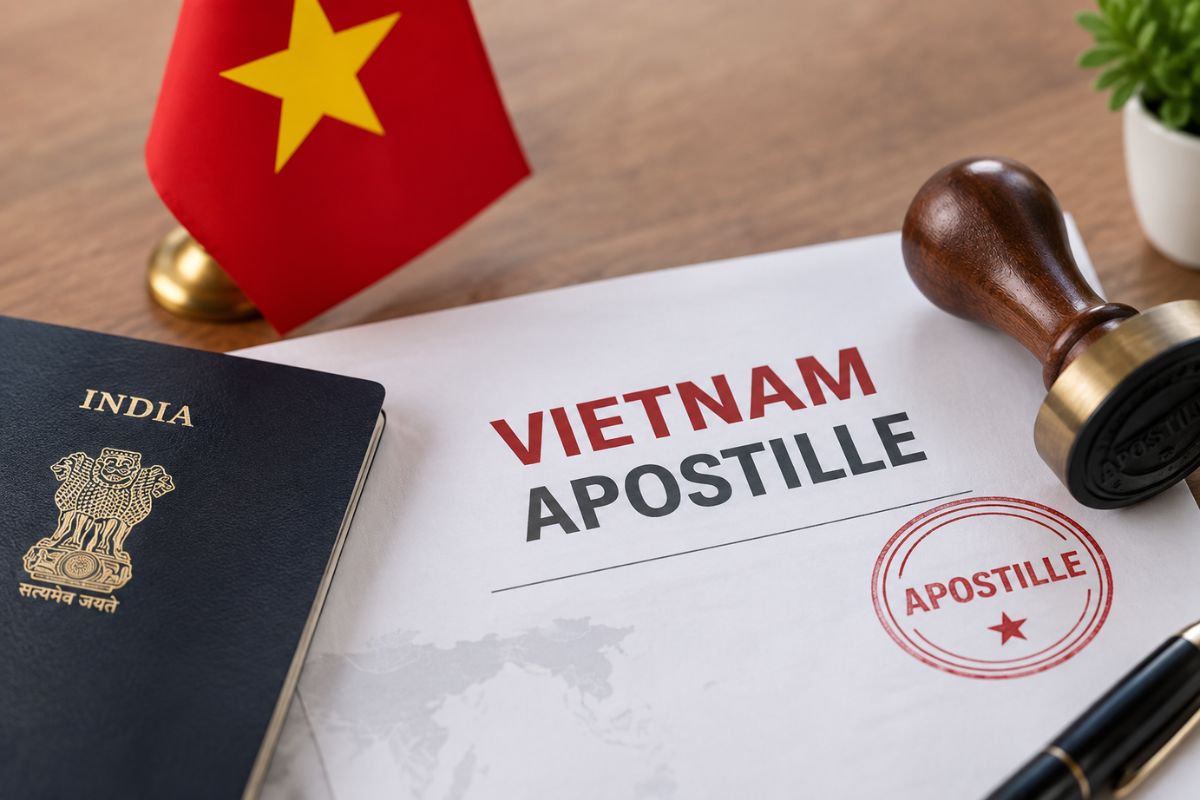
New Document Authentication Rule: Indian Documents for Vietnam Require Apostille from September 11, 2026
Indian travellers, students, workers, and businesses using public documents in Vietnam will face a new, crucial document authentication requirement starting September 11, 2026. From this date, all eligible Indian public documents destined for use in Vietnam must carry an Apostille issued by the competent Indian authority.
This significant policy change means the Embassy of Vietnam in India will cease accepting consular legalisation applications for documents covered by this new Apostille process. It marks a move towards a more standardised international verification system.
What is an Apostille? Understanding the 1961 Hague Apostille Convention
An Apostille is an internationally recognised certification that verifies the authenticity of a document’s official signature, seal, or stamp. Its purpose is to allow eligible public documents to be accepted in other countries that are signatories to the 1961 Hague Apostille Convention without further complex legalisation steps. It certifies the origin of the document (who issued it), but not the accuracy of its content.
Essential Information for Indian Citizens Using Documents in Vietnam
Once an Indian public document has a valid Apostille, it can be used in Vietnam without needing further certification. However, there’s an important language requirement: documents that are not in Vietnamese must also include a notarised or certified Vietnamese translation.
The Embassy has clarified that some specific documents may still require traditional consular legalisation. Therefore, it is crucial for travellers and applicants to verify the exact authentication requirements for their specific document type before submission.
The New Process: How to Authenticate Indian Documents for Vietnam
- Step 1: Obtain Your Document. Secure the necessary Indian public document (e.g., birth certificate, educational degrees, marriage certificate).
- Step 2: Get an Apostille. Obtain an Apostille from the competent Indian authority responsible for document authentication.
- Step 3: Translate (If Necessary). If your document is not in Vietnamese, arrange for a professional notarised or certified Vietnamese translation.
- Step 4: Check for Exceptions. Always confirm whether your particular document falls under any exceptions that still require consular legalisation, rather than an Apostille.
This transition is part of a broader global shift towards Apostille-based document authentication, designed to simplify international procedures and reduce the need for separate embassy legalisation. For Indian students, workers, families, and businesses interacting with Vietnamese authorities, the key change is to ensure your documents are Apostilled first, and translation requirements are met, before submission or travel to Vietnam.
Travelobiz Insight: Plan Ahead for Smooth Document Processing
While this change simplifies the process for many Indian applicants, document-specific checks remain absolutely essential. We recommend obtaining the Apostille early and thoroughly verifying all translation requirements well in advance of submitting any paperwork in Vietnam.
Leave a Reply